
Finding the best garage software in South Africa is no longer a luxury — it is a competitive necessity. Independent workshops, franchise dealerships, and mobile mechanics across the country are discovering that the right workshop management platform can cut admin time in half, reduce parts wastage, and dramatically improve the customer experience. Whether you are operating from a single-bay garage in Polokwane or running a multi-branch service centre in Johannesburg, the software you choose will shape how efficiently your business runs.
This guide walks you through everything you need to know: what to look for, which categories of tools exist, how to evaluate them for local conditions, and what questions to ask before signing a subscription.
Table of Contents
Why South African Workshops Need Dedicated Software
Many garage owners still rely on WhatsApp, handwritten job cards, and Excel spreadsheets to manage their daily workflow. That approach worked a decade ago, but today’s workshop environment is far more demanding. Customers expect digital invoices, SMS updates, and transparent quotes. SARS compliance requires proper record-keeping. And loadshedding — a uniquely South African challenge — makes cloud-based tools with offline capability increasingly valuable.
The best garage software in South Africa is specifically designed — or at least locally adapted — to handle these conditions. That means rand-based invoicing, VAT-compliant tax settings, integration with South African parts suppliers, and support in local business hours.
A workshop running on paper job cards loses an average of 12 billable hours per month to admin errors and miscommunication — that is real revenue walking out the door.
The Real Cost of Manual Processes
It is not just about efficiency. Manual processes introduce risk. A misplaced job card means a vehicle sits on the floor longer than it should. An uninvoiced part means a direct hit to your margin. Forgotten follow-ups mean customers take their next service to a competitor. Software eliminates these failure points systematically.
Common Pain Points Software Solves
- Lost or incomplete job cards causing billing disputes
- No visibility into parts inventory levels until a stockout occurs
- Difficulty tracking mechanic productivity and job turnaround times
- Manual VAT calculations creating SARS compliance risk
- No system for automated customer follow-up or service reminders
- Poor cash flow visibility across the month
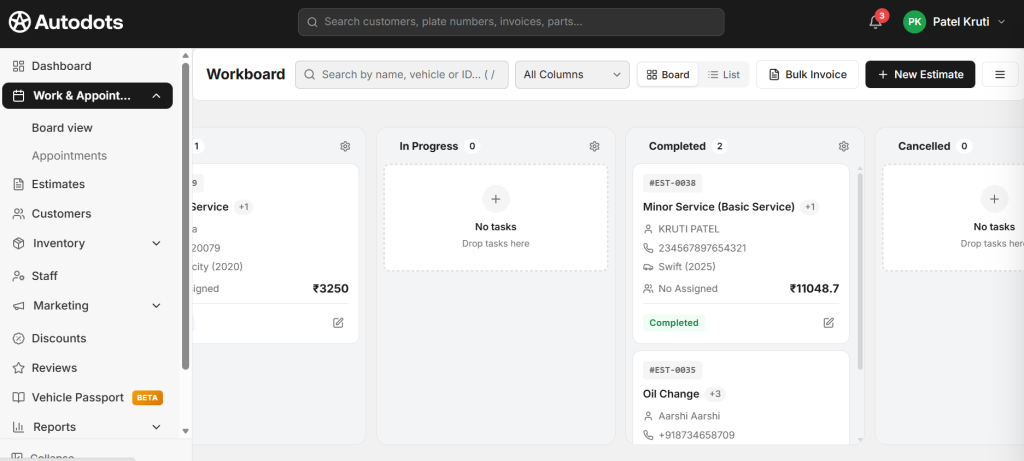
What the Best Garage Software in South Africa Actually Includes
Not all workshop management tools are built equally. The best garage software in South Africa typically bundles several functional modules into a single platform. Understanding these modules helps you evaluate options without being dazzled by feature lists that do not match your actual workflow.
- Job Card Management — Digital creation, assignment, and tracking of every vehicle job from intake to delivery.
- Quoting and Invoicing — VAT-compliant quotes and invoices in rands, with email or SMS delivery to customers.
- Inventory Control — Track parts, set reorder points, and link stock movements to job cards automatically.
- Customer CRM — Full vehicle and service history per customer, enabling targeted follow-ups and loyalty building.
- Reporting and Analytics — Revenue by job type, mechanic efficiency scores, and monthly profit summaries.
- SMS and Communication — Automated service reminders, job-ready notifications, and quote approvals via SMS.
Evaluating Options: A South African Context
Evaluating the best garage software in South Africa requires you to think beyond international feature comparisons. Local context matters enormously. Here are the dimensions that South African workshop owners should weigh most carefully.
Cloud vs. On-Premise: The Loadshedding Factor
Loadshedding is not going away. Any purely cloud-based system that requires constant internet connectivity becomes a liability when power and data services are unreliable. The strongest contenders in the South African market now offer hybrid models — cloud sync when connectivity is available, local data caching when it is not. This is a non-negotiable feature for workshops in areas with persistent infrastructure challenges.
Rand-Based Pricing and VAT Compliance
South African VAT rules are specific. Your software must support 15% VAT calculations natively, generate invoices that meet SARS requirements, and produce reports that your accountant can use without manual reformatting. Software designed for the UK or US market often requires awkward workarounds to achieve this, making locally built or locally adapted platforms significantly more practical.
Integration with Local Parts Suppliers
The ability to pull pricing and availability directly from South African parts distributors — such as Midas, Goldwagen, or regional wholesalers — saves substantial time in the quoting process and reduces pricing errors. This integration capability is one of the sharpest differentiators between generalist tools and platforms genuinely built for the South African market.
Pro tip: Before committing to any platform, ask the vendor specifically about their integration with your top three parts suppliers. Request a live demonstration of a parts lookup within a job card. If they cannot show it to you, it likely does not work as advertised.
Comparing Categories of Workshop Software Available in South Africa
The best garage software in South Africa market broadly divides into three tiers. Understanding where a product sits helps you align your expectations and budget accordingly.
| Category | Best For | Typical Cost | SA-Specific Support | Complexity |
|---|---|---|---|---|
| Entry-Level Tools | Solo mechanics, small bays | R300–R600/month | Partial | Low |
| Mid-Market Platforms | Growing workshops, 2–10 bays | R800–R2,500/month | Strong | Medium |
| Enterprise Solutions | Multi-branch, franchise networks | R3,000+/month | Full | High |
| International Generalist Tools | Tech-savvy owners willing to customise | Varies (USD) | Limited | Medium to High |
Mid-Market Is Often the Sweet Spot
For most independent workshops with two to eight bays, mid-market platforms specifically built for the South African motor trade offer the best return on investment. They are sophisticated enough to handle multi-technician scheduling, parts ordering, and financial reporting, while remaining accessible enough for a team without formal IT skills to adopt within a week.
Key Questions to Ask Before You Buy
Before committing to any subscription for what you believe is the best garage software in South Africa for your workshop, run through this checklist with the vendor:
- Does the software work offline or with limited connectivity during loadshedding?
- Is VAT handling compliant with current SARS regulations?
- Which South African parts supplier catalogues are integrated?
- Is local support available in South African business hours?
- Can I migrate my existing customer and vehicle data from my current system?
- Is there a free trial period before I commit to a subscription?
- How are software updates handled, and do they cost extra?
- Does the platform scale if I open a second location?
Implementation: Getting Your Team Onboard
Even the best garage software in South Africa will fail to deliver results if adoption is poor. Implementation is where most workshop technology projects succeed or falter — not in the selection phase. South African workshop owners consistently report that the biggest barrier is not cost or features, but getting mechanics and service advisors to change their habits.
A Practical Rollout Framework
Start with a single process. If job cards are your biggest pain point, implement the digital job card module first and leave everything else until the team is comfortable. Add invoicing in week two, parts ordering in week three. This phased approach reduces resistance and allows your team to build confidence rather than feeling overwhelmed.
Training Resources to Prioritise
- Vendor-provided video tutorials in simple, non-technical language
- A dedicated WhatsApp group or helpdesk for staff questions during the first month
- Printed quick-reference cards for the workshop floor
- A designated super user in your team who becomes the internal go-to person
Measuring Success After Rollout
Set clear benchmarks before you go live. Track average job turnaround time, invoice error rate, parts wastage percentage, and monthly revenue per bay. Review these metrics at the 30-, 60-, and 90-day marks. The best garage software in South Africa should show measurable improvement in at least two of these areas within the first quarter of proper use.
Get started with Autodots today and see what the right software for garage management can do for your workshop.
The Future of Garage Software in South Africa
The technology landscape for workshop management is evolving rapidly. The next generation of platforms for South African garages will incorporate AI-driven diagnostic suggestions, integrated vehicle telematics, and automated parts reordering based on predictive maintenance patterns. Some platforms are already experimenting with WhatsApp-native job card creation — a natural fit for South Africa’s WhatsApp-first communication culture.
Owners who invest in the best garage software in South Africa today are also positioning themselves to take advantage of these upcoming capabilities. Platforms with strong development roadmaps and local market commitment will continue to improve, making the investment progressively more valuable over time.
The workshops that will thrive in the next five years are not necessarily the ones with the best mechanics — they are the ones with the best systems. Software is the foundation of those systems.
Ultimately, choosing the best garage software in South Africa is about finding a tool that fits your specific operation, your team’s skill level, and your growth ambitions — then committing to using it fully. Half-implemented software delivers half the results. The return on investment becomes very compelling very quickly when a workshop commits to digital-first operations across every touchpoint.
Frequently Asked Questions
Q: What is the best garage software in South Africa for a small workshop?
For a solo mechanic or small bay operation, an entry-level to mid-market platform with digital job cards, basic invoicing, and SMS notifications is typically sufficient. Look for rand-denominated pricing, offline functionality for loadshedding, and local support. Avoid paying for enterprise features like multi-branch management that you will not use for years.
Q: How much does workshop management software cost in South Africa?
Pricing ranges widely. Entry-level tools start around R300 to R600 per month, mid-market platforms run from R800 to R2,500 per month, and enterprise solutions for multi-branch operations can exceed R3,000 per month. Most vendors offer a free trial period, and annual billing typically offers a meaningful discount over month-to-month pricing.
Q: Does garage software work during loadshedding in South Africa?
The better platforms do. Look specifically for software that offers offline functionality or local data caching so that job cards, parts lookups, and invoicing can continue during power outages. When connectivity is restored, the system should sync automatically with the cloud. Always test this feature during a trial before committing to a subscription.
Q: Is South African garage software VAT compliant?
Locally built or locally adapted platforms are generally designed to meet SARS invoice requirements, including correct 15% VAT line-item display and the required business information on tax invoices. International tools often require manual configuration to achieve this. Always confirm VAT compliance with the vendor and test invoice output before going live.
Q: Can garage software integrate with South African parts suppliers?
Yes, several platforms built for the South African market offer direct integration with local distributors, allowing real-time parts pricing and availability lookups from within a job card. This integration varies by vendor and supplier. Always ask which specific suppliers are supported and request a live demonstration of the parts lookup feature before purchasing.
Q: How long does it take to implement garage management software?
A basic implementation — getting your team using digital job cards and invoicing — can be achieved within one to two weeks for most small to mid-sized workshops. A full implementation including inventory setup, customer data migration, and reporting configuration typically takes four to eight weeks depending on the platform and the size of your existing data set.
Ready to Transform Your Workshop?
Explore our in-depth reviews, side-by-side comparisons, and buyer guides to find the right solution for your South African workshop — from solo bay to multi-branch operation. Browse all our workshop software reviews on the blog.
You might already know this: Why Multi Location Auto Repair Software Is a Game Changer for Workshop Chains