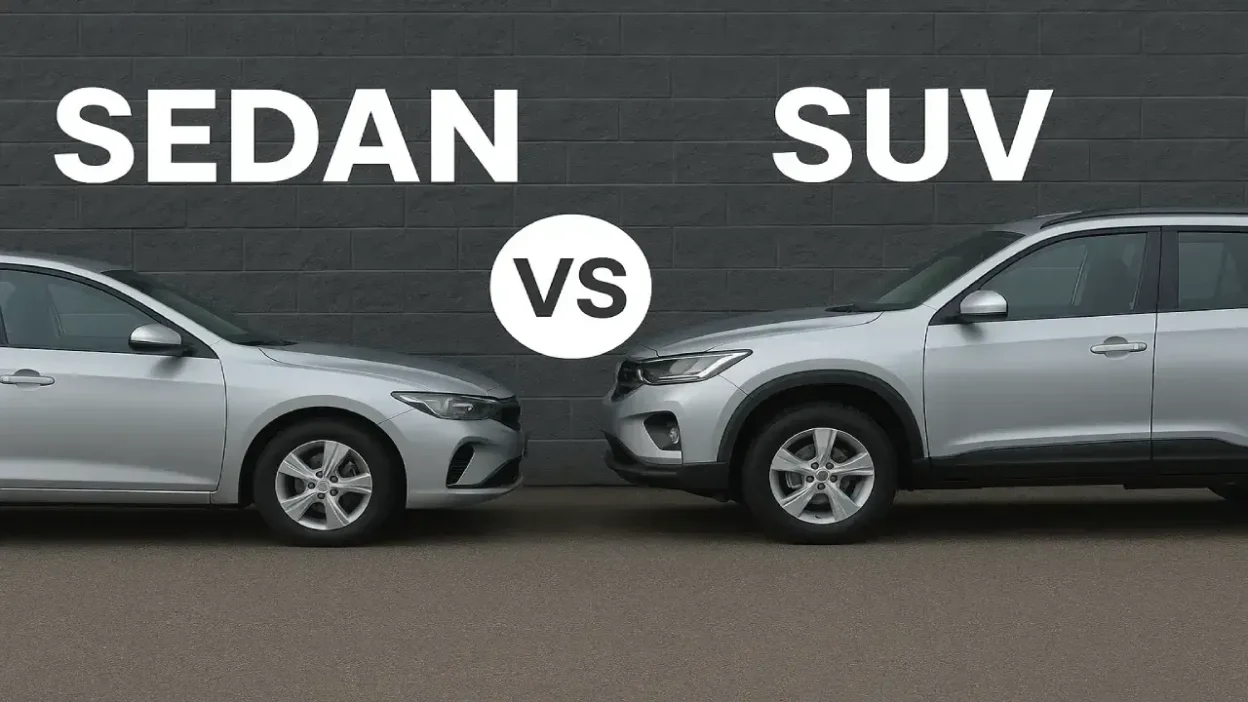
The Sedan vs SUV debate is not new, but in 2026 the dynamics have changed dramatically. Fuel prices, road conditions, family needs, and new car launches have all shifted the equation. Whether you’re a first-time buyer or upgrading your current ride, this guide will help you make the smartest, most informed decision.
Table of Contents
What Exactly Is a Sedan and an SUV?
A Sedan is a traditional three-box car — engine in front, passengers in the middle, and a separate boot (trunk) at the back. Think Maruti Suzuki Ciaz, Honda City, or Hyundai Verna. They sit low, feel sporty, and cut through air efficiently.
An SUV (Sport Utility Vehicle) is a higher-riding vehicle with more ground clearance and usually more cargo space. Think Hyundai Creta, Tata Nexon, or Kia Seltos. They feel commanding on the road and handle rough terrain better.
Sedan vs SUV: Head-to-Head Comparison
| Feature | Sedan | SUV |
|---|---|---|
| Price Range | ₹7L – ₹20L | ₹8L – ₹35L+ |
| Fuel Efficiency | 18–24 kmpl | 14–20 kmpl |
| Ground Clearance | 150–170 mm | 180–220 mm |
| Boot / Cargo Space | 420–500 litres | 400–600 litres+ |
| Seating Comfort | Comfortable (5) | Spacious (5–7) |
| City Driving | Easier, lower height | Slightly harder to park |
| Highway Stability | Better aerodynamics | Good but windier |
| Off-Road Capability | Limited | Much better |
| Maintenance Cost | Lower | Moderate to High |
| Resale Value | Moderate | High (especially SUVs) |
Price & Budget: Which Is More Affordable?
In India’s 2026 car market, Sedans are generally more affordable at the entry and mid-level. A well-equipped Honda City or Skoda Slavia costs around ₹12–16 lakh. An equivalent feature-loaded SUV like the Hyundai Creta or MG Astor starts from ₹14–20 lakh.
However, running costs matter too. Sedans win on fuel economy — they are lighter and more aerodynamic. If you drive 1,500+ km a month, a Sedan could save you ₹3,000–5,000 monthly in fuel alone.
Pro Tip: Don’t just compare showroom prices. Calculate 5-year total ownership cost — EMI, fuel, insurance, and maintenance combined. A cheaper SUV on paper can cost you ₹2–4 lakh more over 5 years.
Who Should Buy a Sedan?
Choose a Sedan
- You drive mostly in cities
- Fuel efficiency is a priority
- Budget is ₹8–18 lakh
- You prefer a sporty, low stance
- Small family (2–4 members)
- Highway driving is frequent
Choose an SUV
- You live in Tier-2/3 cities with bad roads
- Family of 5 or need 7 seats
- Weekend trips & off-roading
- Commanding road presence matters
- Higher boot space needed
- Strong resale value is important
Safety: Which Is Safer in 2026?
Both Sedans and SUVs have significantly improved in safety. Modern Sedans like the Skoda Slavia have received 5-star Global NCAP ratings. SUVs like the Tata Nexon have been India’s safety benchmark for years.
SUVs sit higher, giving drivers better visibility. But they also have a higher center of gravity, which can affect handling in sharp turns. With Electronic Stability Control (ESC) now mandatory in India, both types are safer than ever.
Resale Value: Sedan vs SUV in India
Here’s something most buyers ignore — resale value. In the Indian used car market, SUVs — especially compact SUVs — depreciate slower. A 3-year-old Hyundai Creta or Tata Nexon holds its value far better than an equivalent-age Sedan.
This means if you’re planning to sell your car within 4–5 years, an SUV might actually be the smarter long-term financial choice, despite a higher purchase price.
The Final Verdict: Sedan or SUV?
There’s no universal winner in the Sedan vs SUV debate — it entirely depends on your lifestyle. If you’re a city professional who values efficiency, elegance, and lower running costs, a Sedan is your best friend. If you have a growing family, love road trips, or live where roads get rough, an SUV gives you the confidence and space you need.
In 2026, with so many brilliant options in both segments — from the fuel-efficient Honda City to the feature-packed Hyundai Creta — you genuinely can’t go wrong. Just match your choice to your real-world needs, not just looks or peer pressure.
Smart car buying = matching the car to YOUR life — not the other way around.